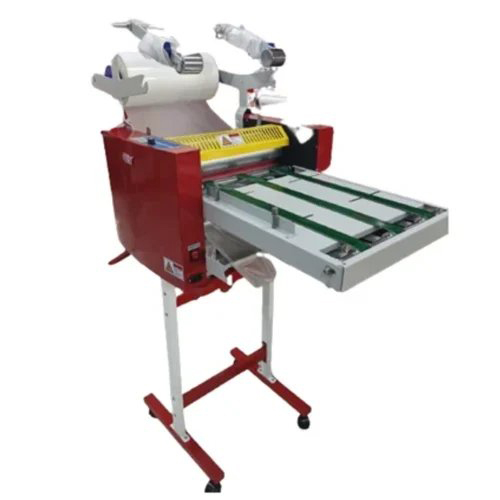
उत्पाद वर्णन
उत्पाद विवरण:
| Minimum Order Quantity |
1 टुकड़ा |
| Number Of Rollers |
4 |
| Laminating Speed |
3000mm/min |
| Film Core |
1" 1.5" 3" core |
| Pressure Adjustment |
Yes |
| Temperature Control |
Manual |
| Speed Control |
Manual |
| Phase |
Single Phase |
| Max Working Temperature |
180 Degree Celsius |
| Power Consumption |
AC 220 ,110V/50,60HZ, 700W |
| Start Up Time |
About 10 minutes |
| Electric Motor |
YES |
| Control System |
Manual |
| Type Of Main Motor |
DC Motor |
| Temperature Range |
180C |
| Substrate Thickness |
5mm |
| Display |
YES |
| Max. Laminating Width |
360 mm |
| Brand |
GBT |
| Model Name/Number |
TLM 380 / 15" |
| Weight |
34kgs |
| Electric |
AC220,110V/ 50,60HZ,700W |
| Dimension |
720x630x470mm (LxWxH) |
| Core Diameter Inch |
1,1.5,3 INCH |
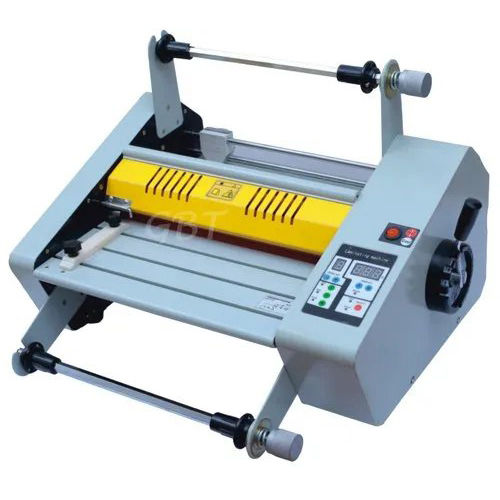
Product IntroductionHeated roll laminator uses heated rollers to melt glue extruded onto lamination film. This film is in turn applied to a substrate such as paper or card using pressure rollers. The primary purpose of laminating with such a machine is to embellish or protect printed documents or images. Heated roll laminators can vary in size from office based pouch laminators to industrial sized machines. Such industrial machines are primarily used for high quantity/quality output by printers or print finishers. Whether small office or industrial machines their primary function is to embellish or protect printed works. Such laminators are used to apply varying thicknesses of lamination film onto substrates such as paper or fabrics. The main advantage to the use of heated roll laminators is that of speed. Heated laminators use heated rollers or heated shoes to melt the glue which is applied to lamination film. The process of heating the glue prior to applying the film to a substrate allows for a faster application of the film. The laminates and adhesives used are generally cheaper to manufacture than cold roll laminates, often as much as half the cost depending on the comparison made. As the materials are non-adhesive until exposed to heat, they are much easier to handle. The glue is solid at room temperature, so lamination of this type is less likely to shift or warp after its application than pressure activated laminates, which rely on a highly viscous, adhesive fluid.Max. Clearance between top Bottom Rollers : 5mmSingle sided Laminating Function : YesDouble sided Laminating Function : YesWith a perforating Blade : NoAuto Feeding Paper : NoHot/Cold Laminating : YesHeating Roller Dia : 44 mmPull Roller Dia : 28.5 mm+18% TAX EXTRA ON MACHINESimplified Automatic LaminationThis lamination machine offers an automatic grade functionality, eliminating the need for manual intervention and ensuring uniform results. Though non-computerized, its electric drive provides steady operation suitable for high-volume tasks. Users benefit from efficient, hassle-free processing and reduced operational time, making it an asset for businesses requiring frequent lamination.
Robust Construction and Practical DesignConstructed with durable rubber rollers and weighing 34 kg, the TLM 14R 380 ensures stability and reliability during use. The compact dimensions enable easy placement in most workspaces without compromising output. Its white exterior matches diverse professional settings, delivering both functionality and aesthetic appeal.
FAQ's of Thermal Lamination Machine 15 TLM 14R 380 (Rubber Roller):
Q: How does the Thermal Lamination Machine 15 TLM 14R 380 operate?
A: The machine runs automatically using an electric power source and drive system. Users simply load the material, initiate lamination, and the rubber rollers ensure an even finish without manual adjustment.
Q: What materials can be laminated using this machine?
A: It is designed for lamination of standard documents, photos, and similar media commonly used by exporters, suppliers, and manufacturers, allowing for versatile business or service applications.
Q: Where is this machine most effective for use?
A: The TLM 14R 380 is suited for commercial environments such as offices, print shops, service centers, and manufacturing units throughout India, especially where consistent lamination is needed.
Q: When should I consider using a thermal lamination machine?
A: This machine is ideal when high-volume, reliable, and uniform lamination is required, reducing manual workload and improving efficiency for businesses handling bulk documents or packaging materials.
Q: What is the lamination process with this machine?
A: Materials are placed between the thermal laminating film, then fed automatically through the rubber rollers. The machine uses heat to bond the layers, producing a smooth, protected surface.
Q: What are the benefits of using this lamination machine over manual methods?
A: The automated process ensures consistent quality, saves time, and minimizes labor, providing reliable protection and professional-looking results without repetitive manual effort.